
Artificial intelligence (AI) is changing the way students learn, study, and manage their academic work. From personalized learning platforms to AI-powered writing assistants and educational chatbots, technology is giving students new ways to understand difficult subjects and improve their productivity.
AI for students does not mean replacing teachers or traditional education. Instead, it can serve as a learning assistant that helps students find explanations, practice concepts, organize information, and develop better study habits.
What Is AI for Students?
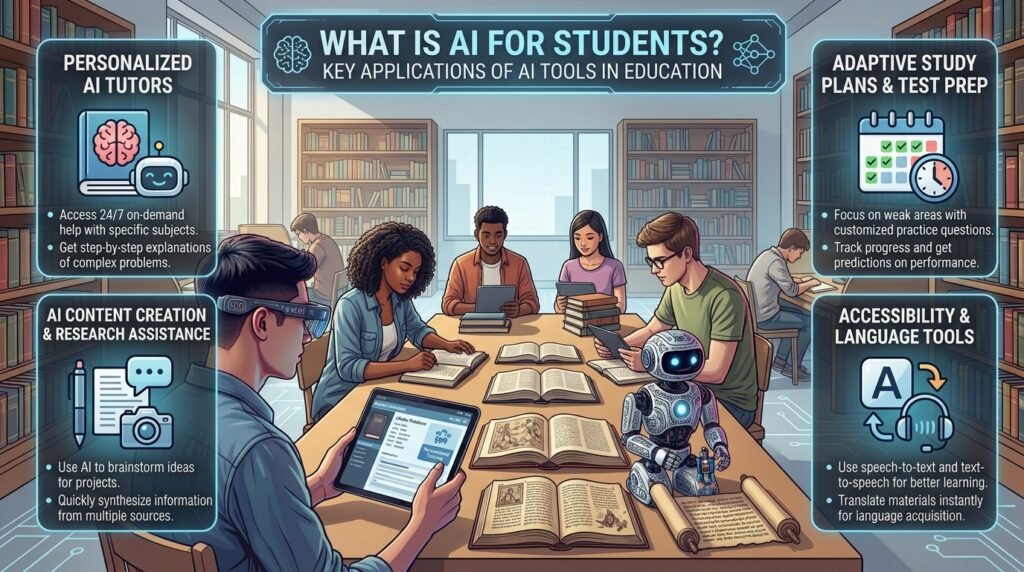
AI for students refers to the use of artificial intelligence tools and applications to support education and academic activities. These tools can understand questions, generate explanations, summarize information, create practice questions, provide feedback, and assist with research.
For example, a student struggling with mathematics can ask an AI tool to explain a problem step by step. A student learning English can use AI to practice grammar and improve sentence structure. Similarly, a university student can use AI to organize research ideas or create a study plan.
The key is to use AI as a learning aid rather than a replacement for independent thinking.
How AI Helps Students Learn
1. Personalized Learning
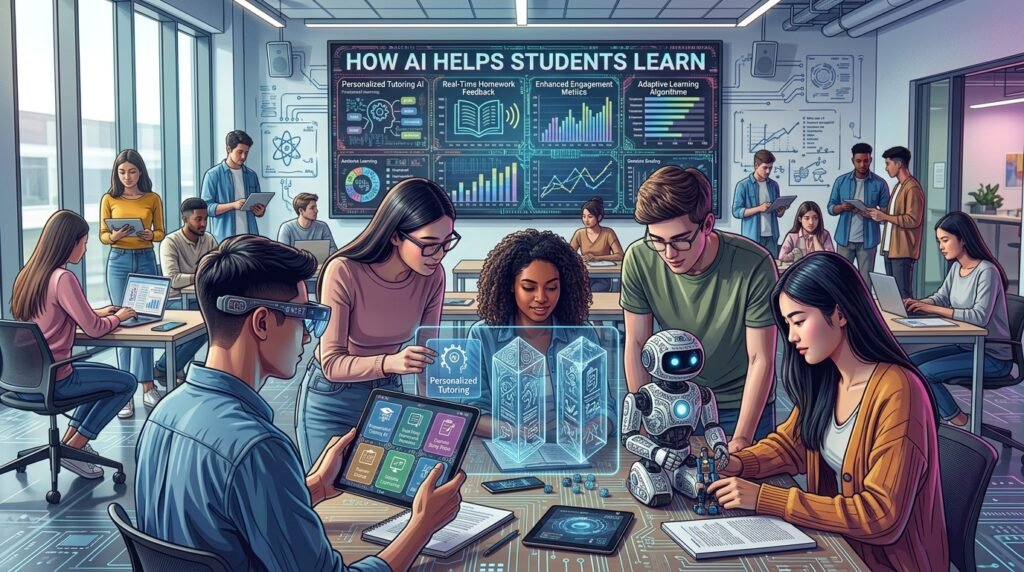
AI for Students: One of the biggest benefits of AI in education is personalized learning. Every student learns differently. Some students understand concepts quickly, while others need additional examples and practice.
AI tools can adjust explanations according to a student’s questions and learning needs. Students can ask for:
- Simple explanations
- Real-world examples
- Step-by-step solutions
- Practice questions
- Quizzes
- Flashcards
- Revision notes
This can make learning more flexible and student-centered.
2. AI Can Explain Difficult Topics
AI for Students often hesitate to ask questions repeatedly in a classroom. An AI assistant can provide another explanation whenever needed.
For example, instead of simply asking:
“What is photosynthesis?”
a student can ask:
“Explain photosynthesis in simple language for a Class 8 student and give me an everyday example.”
The response can then be adapted to the student’s level.
However, students should compare important information with textbooks, teachers, and reliable academic sources because AI systems can sometimes produce incorrect information.
3. Better Study Notes
AI for Students: Creating notes is an important part of academic preparation. AI can help students organize lengthy material into easier-to-review formats.
Students can use AI to turn information into:
- Short notes
- Bullet points
- Tables
- Definitions
- Key concepts
- Question-and-answer formats
- Revision checklists
For example, a student preparing for an examination can ask an AI tool to identify the major concepts from a chapter and create practice questions.
The student should still read and understand the original material rather than relying entirely on an AI-generated summary.
ChatGPT Explains hard topics in easy words, helps write outlines, and solves math or coding problems
4. AI for Exam Preparation
AI for Students: AI can also be useful for examination preparation. Students can request practice questions based on a particular subject or topic.
For example:
Subject: Biology
Topic: Human respiratory system
Study request: 20 multiple-choice questions with answers and explanations.
AI can generate a practice session that allows students to identify areas where they need more revision.
Students can also ask AI to create:
- Mock tests
- Scenario-based questions
- Short-answer questions
- Flashcards
- Viva questions
- Revision schedules
This can make study sessions more interactive.
5. Improving Writing Skills
AI for Students: AI writing tools can help students improve their writing by identifying grammatical errors, unclear sentences, and structural problems.
For example, students can use AI to understand:
- Grammar mistakes
- Sentence structure
- Paragraph organization
- Academic writing
- Vocabulary
- Clarity and readability
Instead of asking AI to write an entire assignment and submitting it unchanged, students can use it to learn why a particular sentence or paragraph needs improvement.
This approach supports learning and develops long-term writing skills.
6. AI for Research
AI for Students: Research can be challenging, particularly for university students. AI can help students brainstorm research topics, identify keywords, organize ideas, and understand complicated concepts.
For example, a student researching climate change might use AI to develop potential research questions such as:
- How does climate change affect agriculture?
- What are the effects of rising temperatures on human health?
- How can renewable energy reduce carbon emissions?
However, AI-generated references should not automatically be considered reliable. Students should verify sources through academic journals, university databases, books, government websites, and other trustworthy resources.
7. Language Learning
AI for Students: AI can provide valuable support for students learning a new language.
Students can practice conversations, vocabulary, grammar, pronunciation concepts, and writing. They can also ask AI to translate difficult sentences and explain unfamiliar words.
For example:
“Explain the difference between ‘affect’ and ‘effect’ with five examples.”
This type of interactive practice can help students learn at their own pace.
8. Time Management and Study Planning
Many students struggle with managing assignments, examinations, classes, and personal responsibilities.
AI can help create a structured study plan based on:
- Subjects
- Available study hours
- Examination dates
- Assignment deadlines
- Difficult topics
- Revision requirements
A student might provide a list of upcoming examinations and ask AI to create a two-week revision schedule.
The final schedule should remain realistic. Students need adequate breaks, sleep, physical activity, and time away from screens.
9. Accessibility for Students
AI for Students: AI can also support students who have different learning needs. Depending on the technology, AI-powered educational tools can assist with reading, writing, language translation, speech-to-text, and other forms of accessibility.
This can make educational content easier to access and understand for a wider range of learners.
Advantages of AI for Students
Some important benefits include:AI for Students:
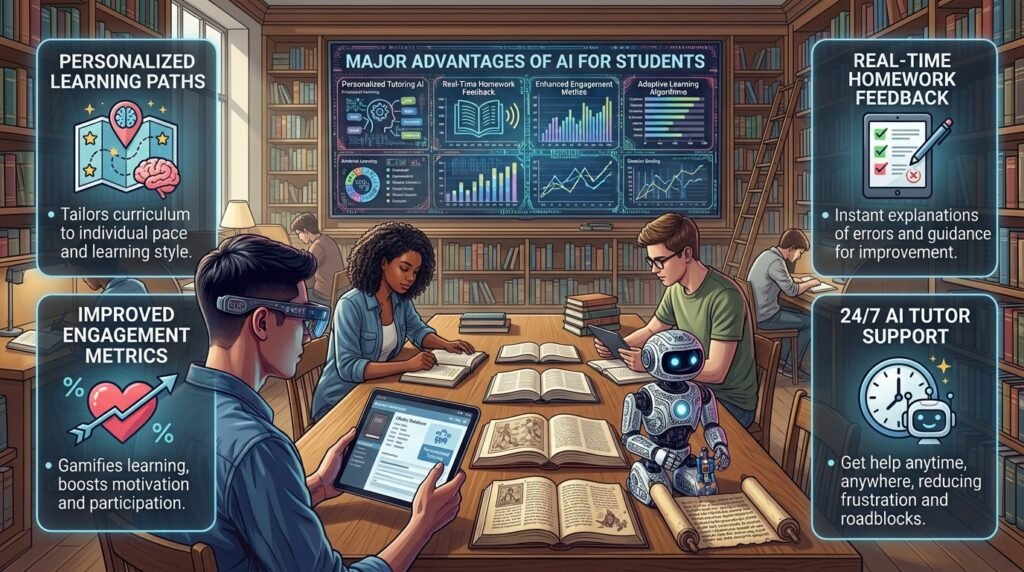
- Faster learning support: Students can receive explanations when they need them.
- Personalized education: Information can be presented at different levels of difficulty.
- Interactive practice: AI can generate quizzes and exercises.
- Better organization: Students can organize notes and study plans.
- Writing assistance: AI can help identify language and grammar problems.
- 24/7 availability: Many AI tools can be accessed whenever students are studying.
- Research assistance: AI can help students develop ideas and research questions.
Challenges of Using AI in Education
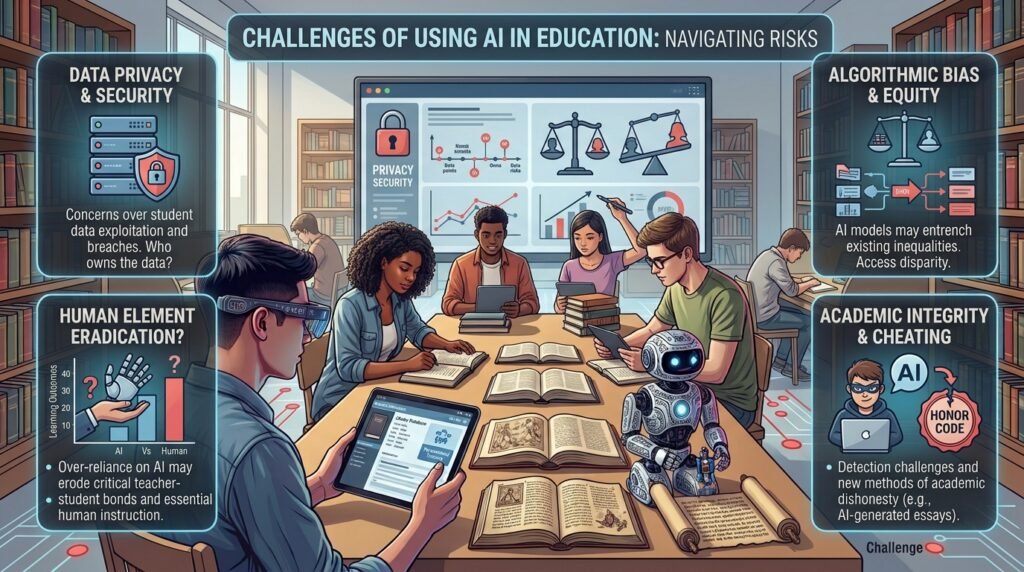
Although AI has many advantages, students should understand its limitations.
Incorrect Information
AI can sometimes provide inaccurate or outdated information. This is especially important for medical, scientific, legal, and other specialized subjects.
Overdependence
If students use AI for every assignment, question, or problem, they may become less confident in solving problems independently.
Academic Integrity
Copying AI-generated content and submitting it as original work may violate a school’s or university’s academic policies. Students should follow their institution’s rules regarding AI use.
Privacy
Students should be careful about entering personal information, confidential documents, passwords, or sensitive academic data into AI platforms.
Reduced Critical Thinking
Simply accepting an AI answer without questioning it can weaken critical-thinking skills. Students should ask: Is this information accurate? What is the evidence? Can I verify it?
How Students Should Use AI Responsibly
The most effective approach is to treat AI as a study partner, not as a shortcut.
A good learning process can look like this:
Learn → Ask → Practice → Verify → Apply → Review
For example, first read a textbook chapter. Then use AI to clarify difficult concepts. After that, solve questions independently. Verify uncertain information using reliable sources, and finally review what you learned without depending on AI.
This approach allows technology to support genuine learning.
AI for Students: The Future of Education
AI is likely to become an increasingly common part of education. Students may encounter more personalized digital tutors, intelligent learning platforms, automated feedback systems, and AI-supported educational resources.
However, technology will not eliminate the importance of teachers. Teachers provide human guidance, experience, motivation, emotional support, classroom interaction, and professional judgment that AI cannot fully replace.
The future of education is therefore likely to involve cooperation between students, teachers, educational resources, and AI technologies.
Conclusion
AI for students offers powerful opportunities to make learning more personalized, interactive, and accessible. Students can use artificial intelligence to understand difficult concepts, create revision materials, practice questions, improve writing, organize study schedules, and support research.
At the same time, responsible use is essential. Students should verify AI-generated information, protect their privacy, follow academic-integrity policies, and continue developing their own critical-thinking and problem-solving skills.
Used correctly, AI should not do the learning for students. It should help students learn better, think deeper, and study smarter.




2 thoughts on “AI for Students: How Artificial Intelligence Is Transforming Learning”