
Information Technology in Banking Sector has changed dramatically over the last few decades. A customer who once had to visit a bank branch, wait in a long queue, and fill out paper forms can now transfer money, pay bills, check account balances, and even apply for financial services from a smartphone.

Behind this transformation is Information Technology (IT).
Information Technology in the banking sector has become an essential part of modern financial services. From online banking and mobile apps to artificial intelligence, cloud computing, cybersecurity, and digital payments, technology is changing how banks operate and how customers manage their money.
But IT is not simply making banking faster. It is also helping banks reduce costs, improve security, understand customer needs, and provide services around the clock.
In this article, we will explore the role of Information Technology in banking, its major applications, benefits, challenges, and the future of digital banking.
What Is Information Technology in Banking?
Information Technology in banking refers to the use of computers, software, networks, databases, digital systems, and other technologies to deliver and manage banking services.
Traditionally, banks depended heavily on physical records and manual processes. Today, most banking activities are supported by interconnected digital systems.
For example, when you use a mobile banking application to transfer money, several IT systems may work together in the background. The system verifies your identity, checks your account balance, processes the transaction, records the activity, and sends confirmation—all within seconds.
This is why IT has become the backbone of modern banking.
Why Is IT Important in the Banking Sector?
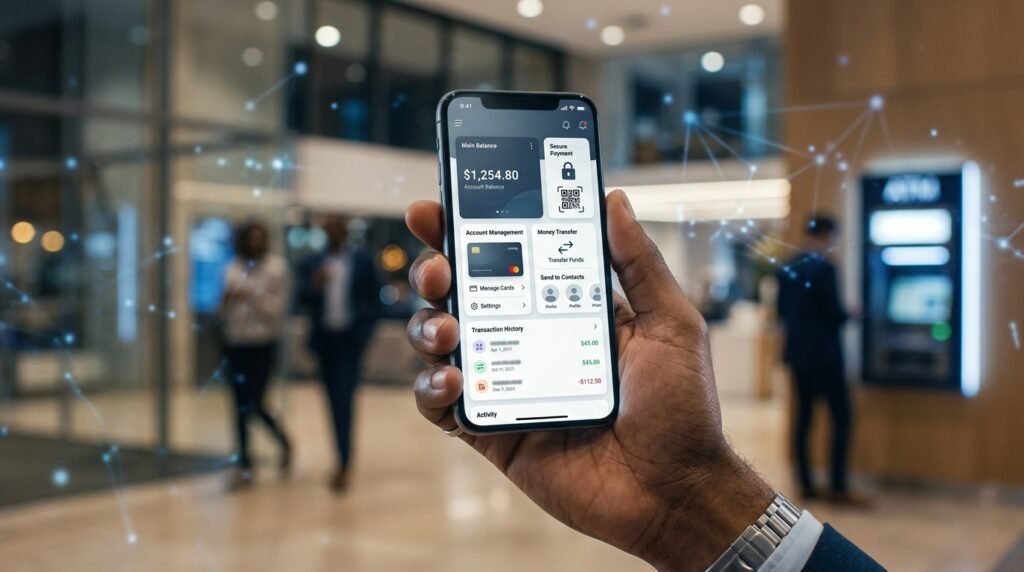
Information Technology in Banking Sector: Banks handle enormous amounts of financial and personal information every day. They need reliable systems to process transactions accurately while protecting sensitive customer data.
Information Technology helps banks achieve these goals in several ways.
1. Faster Banking Services
Technology has dramatically reduced the time required to perform many banking transactions.
Customers can now:
- Transfer money within seconds
- Check account balances instantly
- Pay utility bills online
- Receive transaction notifications
- Deposit money through digital channels
- Apply for certain banking products online
This saves time for both customers and bank employees.
2. 24/7 Banking
Traditional bank branches generally operate during specific hours. Digital banking has changed that model.
Through mobile banking and internet banking, customers can access many services at any time of the day.
Whether someone wants to check a balance at midnight or transfer money on a weekend, digital banking can make these services available without requiring a physical visit to a branch.
3. Better Customer Experience
Modern customers expect convenience.
Banks use technology to make their services simpler and more personalized. Mobile applications, online banking portals, automated notifications, chatbots, and digital payment systems allow customers to interact with their banks through channels they already use.
A smooth digital experience can also reduce the need to visit a branch for routine tasks.
Major Uses of Information Technology in Banking
Information Technology in Banking Sector:: IT is involved in almost every major banking function. Let’s look at some of the most important applications.

1. Online Banking
Information Technology in Banking Sector:: Online banking allows customers to access their accounts through a website or digital portal.
Depending on the bank, customers may be able to:
- View account statements
- Transfer funds
- Pay bills
- Manage cards
- Download transaction records
- Request certain services
- Manage beneficiaries
Online banking has made financial management much more convenient.
2. Mobile Banking
Mobile banking has taken digital banking even further.
With a smartphone and banking application, customers can perform many everyday transactions without visiting a branch.
Mobile banking apps commonly provide features such as:
- Balance checking
- Fund transfers
- Bill payments
- Mobile top-ups
- Card management
- Digital statements
- Transaction alerts
- Biometric authentication
The increasing use of smartphones has made mobile banking one of the most important areas of financial technology.
3. ATMs
Automated Teller Machines, commonly known as ATMs, were among the earliest technologies to bring banking services outside traditional branches.
ATMs allow customers to perform basic transactions such as:
- Cash withdrawal
- Balance inquiry
- Cash deposits in supported machines
- Mini statements
- PIN-related services
Although newer digital services have emerged, ATMs remain an important part of banking infrastructure.
4. Digital Payments
Digital payment technology has transformed the way people pay for goods and services.
Customers can now make payments using:
- Debit and credit cards
- Mobile wallets
- QR codes
- Internet banking
- Contactless payments
- Digital payment applications
For businesses, digital payments can also make transaction records easier to manage.
5. Core Banking Systems
Information Technology in Banking Sector:: A core banking system is one of the most important IT components of a modern bank.
It connects different banking operations and allows customer accounts and transactions to be managed through centralized systems.
For example, a customer may open an account in one branch and access it through another branch or digital channel, depending on the bank’s infrastructure.
Core banking systems help banks manage deposits, withdrawals, loans, customer accounts, transactions, and other services.
6. Artificial Intelligence in Banking
Information Technology in Banking Sector:: Artificial Intelligence is becoming increasingly important in the financial industry.
Banks can use AI for applications such as:
- Fraud detection
- Customer support
- Transaction monitoring
- Risk analysis
- Personalized recommendations
- Document processing
- Credit assessment
AI-powered chatbots can also answer common customer questions without requiring a human employee to handle every request.
However, AI systems must be carefully designed and monitored because banking decisions can have significant financial consequences.
7. Cybersecurity

As banking becomes more digital, cybersecurity becomes increasingly important.
Banks are attractive targets for cybercriminals because they manage valuable financial and personal information. Information Technology in Banking Sector:
Modern banks use technologies and security practices such as:
- Encryption
- Multi-factor authentication
- Biometric verification
- Fraud monitoring
- Secure networks
- Firewalls
- Security monitoring systems
- Real-time transaction alerts
Customers also have an important role to play. Strong passwords, secure devices, and awareness of phishing scams can help reduce security risks.
8. Cloud Computing

Cloud computing allows organizations to access computing resources and services through remote infrastructure.
Banks are increasingly exploring cloud technologies for areas such as data processing, software development, analytics, storage, and digital services.
Cloud platforms can provide scalability and flexibility, although banks must carefully consider security, regulatory requirements, privacy, and operational resilience. Information Technology in Banking Sector:
9. Big Data and Data Analytics
Banks generate huge amounts of data through customer transactions and interactions.
Data analytics can help banks understand patterns and identify unusual activity.
For example, analyzing transaction data may help a bank identify potentially fraudulent behavior or understand how customers use particular services.
Data can also help banks improve products and make more informed business decisions.
Benefits of Information Technology in Banking
The adoption of IT has created significant benefits for both banks and customers. Information Technology in Banking Sector:
Convenience
Customers can access many services without physically visiting a branch.
Speed
Digital systems can process transactions much faster than many manual processes.
Accuracy
Automated systems can reduce certain types of human error associated with repetitive manual data entry.
Lower Operational Costs
Digital processes can reduce paperwork and improve the efficiency of banking operations.
Improved Security
Modern security technologies can help banks detect suspicious transactions and protect sensitive information.
Better Decision-Making
Data analytics and AI can provide banks with additional information for managing risk and developing services.
Wider Financial Access
Digital banking can make financial services more accessible to people who may live far from traditional bank branches, depending on connectivity and availability.
Challenges of Information Technology in Banking
Technology brings major benefits, but it also creates new challenges. Information Technology in Banking Sector:
Cybersecurity Threats
Phishing, malware, account takeovers, identity theft, and other cyber threats remain serious concerns.
A successful cyberattack can cause financial losses and damage customer trust.
Privacy Concerns
Banks collect large amounts of sensitive customer information. Protecting this data and using it responsibly is essential.
System Downtime
Even advanced digital systems can experience technical problems.
When online banking or payment systems go offline, customers may temporarily lose access to important services.
High Implementation Costs
Developing and maintaining secure banking technology requires significant investment in software, infrastructure, cybersecurity, skilled employees, and compliance.Information Technology in Banking Sector:
Digital Literacy
Not every customer is equally comfortable using mobile applications or online banking.
Banks need to provide accessible services and support for customers who may have limited digital skills.
Role of IT Professionals in Banking
Information Technology has also created a wide range of career opportunities within the banking industry.
Banks need professionals such as:
- Software developers
- Network engineers
- Cybersecurity specialists
- Database administrators
- Cloud engineers
- Data analysts
- AI and machine learning specialists
- IT support professionals
- Systems administrators
- Technology project managers
These professionals work behind the scenes to keep banking services available, secure, and reliable.
Information Technology in Banking in Pakistan
Pakistan’s banking industry has also experienced significant digital transformation.
Customers increasingly use mobile banking applications, ATMs, internet banking, digital wallets, cards, and electronic payment services. Information Technology in Banking Sector:
The growth of digital financial services is particularly important in a country where reaching a physical bank branch may not always be convenient for every customer.
However, challenges such as cybersecurity awareness, internet access, digital literacy, fraud prevention, and customer trust remain important considerations.
The continued development of digital payment infrastructure and financial technology is likely to play an important role in expanding access to financial services.
The Future of IT in Banking
The future of banking will likely involve even deeper integration between financial services and technology.
Artificial intelligence, machine learning, cloud computing, automation, biometrics, blockchain-based technologies, open banking, and advanced analytics are among the technologies influencing the industry.
Banks may increasingly focus on providing personalized digital experiences rather than simply offering traditional financial products.
At the same time, cybersecurity and privacy will become even more important as more financial activity moves online.
The future of banking is therefore not simply about adopting the newest technology. It is about using technology responsibly while maintaining security, reliability, transparency, and customer trust.
Final Thoughts
Information Technology has completely changed the banking sector. From ATMs and online banking to mobile apps, artificial intelligence, cybersecurity, cloud computing, and digital payments, technology has become an essential part of modern financial services.

For customers, IT means greater convenience and faster access to many banking services. For banks, it provides tools to automate operations, analyze data, manage risks, and develop new services.
However, digital transformation also comes with responsibilities. Banks must continuously improve cybersecurity, protect customer information, maintain reliable systems, and ensure that digital services remain accessible.
As technology continues to evolve, the relationship between IT and banking will become even stronger. The banks that successfully combine technology with security, reliability, and good customer service will be better positioned to meet the changing expectations of the digital economy.
Frequently Asked Questions
1. What is Information Technology in banking?
Information Technology in banking refers to the use of computers, software, networks, databases, and digital technologies to provide and manage banking services.
2. Why is IT important in the banking sector?
IT helps banks provide faster services, improve operational efficiency, support digital payments, protect information, analyze data, and provide services through digital channels.
3. How does AI help banks?
AI can be used for fraud detection, customer support, transaction monitoring, data analysis, document processing, and other banking functions.
4. What are the disadvantages of IT in banking?
Major challenges include cybersecurity threats, privacy concerns, technical failures, implementation costs, and the digital skills gap.
5. What is the future of IT in banking?
The future is likely to involve greater use of AI, cloud computing, automation, advanced analytics, biometrics, d


Hey team aioguides.com,
I’d love to discuss how we can grow your online visibility.
We help businesses rank higher on Google while also increasing their presence on AI-powered search platforms like ChatGPT, Gemini, Claude, and Perplexity.
Our SEO + AEO + GEO strategies help brands get discovered wherever customers search for answers.
May I send you a quote & price list?
Cheers,
Bakar Berete | Founder & Project Head
Hi,
You probably noticed we went quiet.
We did shut down FreeB2BData — but it wasn’t the end. We took it offline to rebuild it from scratch, much bigger and much better.
The new version is live.
Here’s what’s inside:
900 million people — names, job titles, companies, verified emails
33 million companies — full business records with phones, emails, websites, and addresses
All data is live — always current, always fresh
Unlimited exports — download as much as you want, whenever you want
To mark the relaunch, we’re running a launch promo:
Lifetime access for just $50 — one-time payment, no subscription, no renewals, unlimited exports forever.
But it’s strictly limited — only 20 seats left.
Claim your lifetime seat here https://Zoila.freeb2bdata.org
— The FreeB2BData Team
Thank You very Much.
We will be there if needed.
Hey team aioguides.com,
I would like to discuss SEO!
We help businesses rank higher on Google while also increasing their presence on AI-powered search platforms like ChatGPT, Gemini, Claude, and Perplexity.
Our SEO + AEO + GEO strategies help brands get discovered wherever customers search for answers.
Would you like me to send you our proposal and pricing?
Cheers,
Bakar Berete | Founder & Project Head
Hey team aioguides.com,
I would like to discuss AI SEO!
We help businesses rank higher on Google while also increasing their presence on AI-powered search platforms like ChatGPT, Gemini, Claude, and Perplexity.
Our SEO + AEO + GEO strategies help brands get discovered wherever customers search for answers.
Would you like me to send you our proposal and pricing?
Cheers,
Bakar Berete | Founder & Project Head