
Introduction
Learning Management Systems are teaching and knowledge sharing are done as a result of technology. Students can now acquire an education outside of traditional classrooms. These days, students can watch instructional videos, complete assignments, attend online classes, and interact with teachers via digital platforms. The Learning Management System (LMS) is one of the key technologies driving this change.
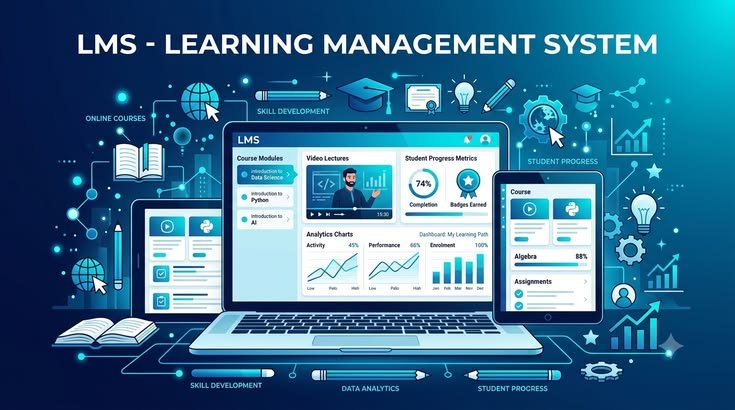
A learning management system is a digital platform that facilitates the creation, administration, delivery, and tracking of learning activities for educational institutions, corporations, training groups, and universities. Assignments, tests, communication tools, and educational materials are all gathered in one handy place.
What Is a Learning Management System?
Software used to plan and oversee training or educational initiatives is called a learning management system, or LMS. It offers a central online location where administrators can track student progress, instructors can post educational resources, and students can access lessons..
An LMS can be used, for instance, by a teacher to distribute notes, post video lectures, make tests, gather homework, and give comments. Every time they need to reread course materials or check their grades, students can log in.
How Does a Learning Management System Work?
A learning management system connects administrators, teachers, students, and educational materials on a unified platform.
- Create an Account
Registering or obtaining login credentials from a school, institution, training provider, or employer is the initial step. Access is granted to users based on the responsibilities they have been assigned.
- Create or Upload Courses
Presentations, papers, videos, reading materials, and other instructional resources are added by instructors and administrators to create courses.
- Enroll Learners
Employees or students are enrolled in the relevant courses. While some systems let users register on their own, others need administrator approval or an invitation.
- Deliver Learning Materials
Lessons are accessed by students via the site. They might study on their own, participate in group activities, or attend regular online sessions, depending on the course.
- Complete Assessments
To measure students’ comprehension, teachers can design examinations, assignments, quizzes, and other exercises. While some tests are automatically scored, others need to be evaluated by hand.
- Track Learning Progress
The system keeps track of things like grades, participation, quiz scores, and course completion. These reports can be used by educators and administrators to pinpoint areas in which students might want further assistance.
Key Features of a Learning Management System.
- Course Management
Teachers can produce, arrange, update, and disseminate instructional materials with the help of course management. To help students follow a logical learning path, lessons might be broken up into chapters or modules.
2. Online Assessments and Quizzes
Online tests, quizzes, assignments, and exams are supported by numerous LMS platforms. Teachers can assess students’ knowledge and pinpoint areas for improvement with the use of these tools.
- Student Progress Tracking
Teachers can keep an eye on student involvement, assessment outcomes, and course completion with the use of progress-tracking software. Additionally, students can use these characteristics to comprehend their accomplishments and pinpoint areas in which they need to improve..
- Communication Tools
Notifications, texting, announcements, and discussion boards facilitate communication between students and instructors.
- Learning Analytics and Reports
Learning analytics transform instructional activities into valuable data. Teachers can examine the efficacy of the course materials, identify students who have fallen behind, and check assessment outcomes.
- Mobile Learning
Students can use smartphones and tablets to study thanks to mobile-friendly platforms. Students may be able to download resources and finish tasks offline, depending on the application.
- Certificates and Course Completion
When students finish courses or fulfill particular evaluation requirements, many systems enable administrators to award certificates. Workplace training and professional development can benefit from this feature.
- User Roles and Permissions
Students, instructors, course supervisors, and administrators are among the several roles that an LMS typically supports. Permissions are granted to each function in accordance with its duties.
Types of Learning Management Systems
Learning management systems can be categorized based on who uses them, how learning is delivered, and how they are hosted.
- Cloud-Based Learning Management Systems
Online infrastructure run by a service provider powers cloud-based LMS platforms. Usually, users use an application or web browser to access the system.
Ideal for: Organizations seeking easy access to the internet, small enterprises, schools, and training providers.
- Self-Hosted Learning Management Systems
The infrastructure used to deploy and manage a self-hosted LMS is controlled by an organization or its hosting provider. This setup may allow for more control over data management, integrations, and customization. The company may need technical staff to handle security upgrades, backups, and maintenance. Best for: Institutions with specialized infrastructure needs or those requiring more technical control.
- Open-Source Learning Management Systems
Open-source LMS software makes its source code available under an applicable open-source license. Organizations can often tweak the platform, add integrations, and adjust its layout.
Even if there isn’t a license charge for the software, there may still be expenses associated with hosting, development, support, and maintenance.
Ideal for: Organizations and educational institutions with access to technical help and a need for flexibility.
- Corporate Learning Management Systems
Professional development, compliance education, onboarding, and employee training are given top priority in corporate LMS solutions.
Businesses can use these systems to offer training materials, track completion, and document required learning activities.
Perfect for: Associations for professional training, businesses, and human resources departments.
- Academic Learning Management Systems
Schools, colleges, universities, and other educational establishments are the target audience for academic LMS platforms.
These frequently include discussion boards, contact between students and teachers, grading, task submission, and course management.
Ideal for: Schools, colleges, universities, teachers, and students.
- Blended Learning Systems
Online learning activities are combined with traditional classroom education in blended learning. By offering digital resources prior to or following class sessions, an LMS can facilitate this strategy.
For instance, students may watch a lecture that has been recorded at home and then participate in a practical exercise during their subsequent class.
Ideal for: Organizations that integrate in-person instruction with online learning.
Benefits of Learning Management Systems
For students, instructors, companies, and educational institutions, learning management systems provide a number of advantages.
- Flexible Learning Opportunities
Flexibility is one of the main benefits of an LMS. Students can revisit challenging ideas at their own pace because they frequently have access to learning resources outside of scheduled class times.
Distance learners, working professionals, and those juggling education with other obligations may particularly benefit from this flexibility.
- Centralized Educational Resources
Course materials are kept in one well-organized location by an LMS. Finding assignments and lecture notes doesn’t require students to go through numerous emails, websites, or printed papers.
Additionally, teachers don’t need to distribute new printed copies in order to update resources.
- Improved Teaching Efficiency
Instructors can automate some administrative duties, arrange exams, and reuse course structures. Students can receive quicker feedback and less repetitious work when appropriate question types are automatically graded.
This enables teachers to devote more time to elucidating complex subjects and assisting specific students.
- Better Student Progress Monitoring
Teachers can identify students who might need further help by using progress reports. For instance, a teacher may observe that a number of pupils do poorly on a given test and offer an additional explanation of the subject.
Progress reports, however, function best when paired with teacher discretion and open dialog with students.
- Support for Distance Education
With the use of an LMS, educational institutions can administer tests and deliver course materials without requiring all students to come to the same physical location.
It can facilitate international education and remote teaching when paired with the right communication tools.
- Reduced Paperwork
Printed materials and manual recordkeeping can be eliminated with the use of digital assignments, online tests, and electronic course materials.
The platform, installation expenses, and the institution’s current procedures all affect the real savings.
- Opportunities for Personalized Learning
Learning pathways, adaptive tests, and suggestions based on student performance are supported by certain LMS platforms.
These characteristics can assist students in concentrating on areas that require additional work. Appropriate learning materials and careful instructional design are still necessary for effective personalization.
- Scalable Training
An LMS can be used by organizations to provide uniform training to numerous employees or students in several places.
Organizations can distribute standardized courses and track completion centrally rather of setting up individual in-person sessions for each group.
Popular Examples of Learning Management Systems
There are numerous LMS platforms available for various commercial and educational requirements. Budget, technological specifications, audience size, and desired features all influence the best option.
Moodle
Organizations and educational institutions use Moodle, an open-source learning management system. It facilitates the establishment of courses, assignments, tests, discussion boards, and a number of extensions.
Organizations looking to personalize their learning environment find it appealing due to its versatility. However, depending on how it is implemented, hosting and administration could call for technical know-how.
Google Classroom
Google Classroom assists educators in managing classroom activities, communicating with students, sharing instructional materials, and organizing assignments. It is compatible with other Google educational resources.
It is frequently appropriate for educational institutions and instructors looking for a simple digital learning environment. The kind of account and related Google services determine the features that are offered.
Canvas LMS
Educational institutions utilize Canvas, a learning management system, to arrange classes, tests, learning materials, and correspondence.
It facilitates integrations with various educational technology and offers resources for both teachers and students.
Blackboard Learn
An educational platform called Blackboard Learn was created to assist educational institutions in managing online courses, tests, and instructional activities. The product and configuration chosen by the organization determine its capabilities and services.
Talent LMS
Talent LMS is a cloud-based training platform that is frequently connected to employee and corporate education. It can be used by organizations to design courses, assign training, and track the development of learners.
Examine a platform’s current cost, support options, accessibility features, integrations, and data security guidelines before selecting one.
Learning Management Systems in Education
Teaching and learning are now organized differently in educational institutions thanks to learning management systems.
Assisting Teachers
With an LMS, educators can create digital classes, upload presentations, assign homework, and share significant announcements.
Helping Students Learn Independently
Students can go over materials, go over challenging lessons again, and keep an eye on assignment due dates. This motivates individuals to assume more accountability for their academic management.
Students do not have to work alone in order to study independently. Teachers are still crucial for clarifications, criticism, support, and academic direction.
Supporting Parents and Guardians
Certain educational systems give parents or guardians access to specific data regarding their children’s attendance, assignments, and progress.

Learning Management Systems for Businesses
LMS platforms are used by businesses to manage professional development, train staff, and enhance skills.
Employee Onboarding
The company’s policies, working practices, available resources, and job responsibilities can all be covered in introduction training for new hires.
This aids companies in providing new team members with consistent information.
Compliance Training
Certain sectors mandate that employees undergo particular training. Courses can be assigned, completion can be tracked, and pertinent training records can be maintained via an LMS.
Businesses should make sure that its system complies with all applicable legal, regulatory, and recordkeeping obligations.
Professional Development
Online courses can help workers improve their technical, managerial, communication, and other professional skills.
Organizations can link learning opportunities with job needs and career development objectives with the aid of a well-designed LMS.
Remote Employee Training
Companies with geographically dispersed or remote teams can conduct training without requiring everyone to meet in one place.
This can facilitate scheduling and enable the availability of educational materials in many time zones.
viding downloadable information, low-bandwidth content, accessible facilities, and, when available, suitable offline alternatives.

Conclusion
Learning management systems are now crucial resources for professional training and contemporary education. From a single platform, they assist organizations in managing structured learning programs, teachers in planning classes, and students in accessing educational resources.
Flexible learning, consolidated resources, better progress tracking, less paperwork, and support for online and mixed learning are some of its advantages. Internet availability, technical assistance, student participation, accessibility, and data security must all be taken into consideration for implementation to be successful.