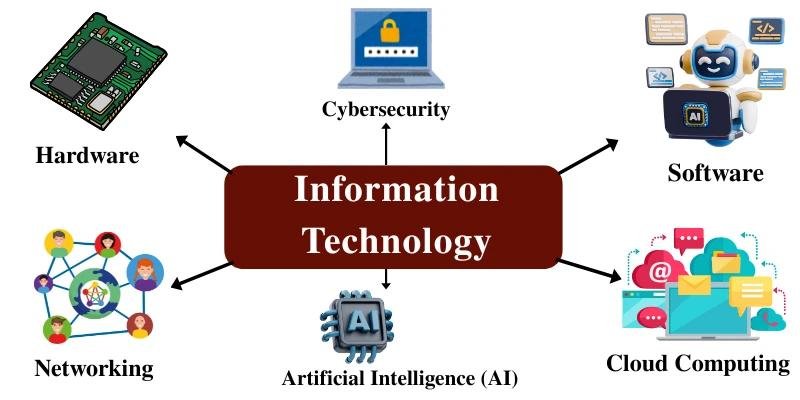

How AI is changing IT jobs is one of the biggest questions facing technology professionals today. Artificial intelligence is changing how software is developed, data is analyzed, cybersecurity is managed, and IT support is delivered. While some repetitive tasks are becoming automated, AI is also creating new roles and increasing demand for professionals who know how to work with these technologies.

How AI Is Changing Information Technology Jobs: From writing code and testing software to cybersecurity, technical support, data analysis, and cloud management, AI tools are changing how IT professionals perform their jobs. Some repetitive tasks can now be automated, while new roles and skills are emerging around AI.
But what does this mean for IT professionals?
Will AI replace programmers, network administrators, cybersecurity specialists, and other technology workers? Or will AI simply become another powerful tool that helps them work faster?
The answer is more complicated than simply saying “AI will take IT jobs.”
AI is changing what IT professionals do, which skills employers value, and how technology teams operate.
What Is AI Doing in the IT Industry?

AI refers to computer systems that can perform tasks that traditionally require human intelligence, such as understanding language, recognizing patterns, generating content, analyzing information, and making predictions.
Generative AI has accelerated this transformation. Modern AI assistants can help developers generate code, explain technical errors, write documentation, analyze datasets, create test cases, and troubleshoot problems.
For IT teams, this means that some tasks that previously required significant amounts of manual work can now be completed with AI assistance.
However, AI-generated output still requires human review. IT professionals must understand the technology, verify results, identify errors, and make decisions based on business and security requirements.
How AI Is Changing IT Jobs
1. Software Development Is Becoming AI-Assisted
Software development is one of the areas experiencing significant changes from generative AI.
How AI Is Changing IT Jobs: AI coding assistants can help developers:
- Generate code
- Explain unfamiliar code
- Find potential bugs
- Create test cases
- Refactor existing code
- Generate documentation
- Suggest solutions to programming problems
- Convert code between programming languages
Instead of spending all their time writing individual lines of code, developers can increasingly focus on architecture, problem-solving, reviewing AI-generated code, security, and understanding business requirements.
This does not mean that programming knowledge is becoming unnecessary.
In fact, understanding programming fundamentals may become even more important because developers need to determine whether AI-generated code is correct, secure, efficient, and maintainable.
2. IT Support Is Becoming More Automated
Traditional IT support involves answering common questions, troubleshooting problems, resetting passwords, installing software, and helping employees resolve technical issues.
How AI Is Changing IT Jobs: AI-powered systems can handle many repetitive support requests.
For example, an AI assistant could help an employee troubleshoot a software problem or provide instructions for configuring a device.
This can reduce the workload associated with simple support tickets.
However, How AI Is Changing IT Jobs: complex problems still require human professionals. IT support specialists may increasingly focus on unusual technical issues, system administration, security incidents, infrastructure problems, and situations requiring communication with users.
The role may therefore shift from answering every question manually to managing and solving more complex problems with AI assistance.
3. Cybersecurity Is Becoming an AI-Powered Field
Cybersecurity professionals face enormous amounts of information every day, including system logs, alerts, network activity, vulnerabilities, and suspicious behavior.
AI can help security teams analyze this information more quickly. How AI Is Changing IT Jobs:
AI-powered cybersecurity systems can assist with:
- Detecting unusual activity
- Identifying potential threats
- Analyzing large datasets
- Prioritizing security alerts
- Detecting suspicious patterns
- Supporting incident investigations
- Automating parts of security monitoring
At the same time, cybercriminals can also use AI to create more sophisticated attacks.
This creates a continuing need for cybersecurity professionals who understand both traditional security principles and AI-related threats.
As a result, knowledge of AI security, threat detection, cloud security, identity management, and cybersecurity automation can become increasingly valuable.
4. Data Analysis Is Changing
Data analysts traditionally spend significant time collecting, cleaning, organizing, and analyzing data.
How AI Is Changing IT Jobs: AI can automate or accelerate some of these activities.
Modern AI tools can help professionals:
- Summarize datasets
- Identify trends
- Generate reports
- Create visualizations
- Write SQL queries
- Explain statistical results
- Detect unusual patterns
But AI does not automatically understand the business meaning behind every dataset.
A human analyst still needs to determine which questions matter, whether the data is reliable, and whether an AI-generated conclusion makes sense.
This means data professionals may spend more time on interpretation, business strategy, and decision-making and less time on repetitive data preparation.
5. Cloud Computing and DevOps Are Evolving
Cloud engineers and DevOps professionals manage complex infrastructure, deployments, monitoring systems, and automation pipelines.
AI can assist with infrastructure monitoring, anomaly detection, resource optimization, log analysis, and troubleshooting.
How AI Is Changing IT Jobs: AI can also help engineers generate configuration files and automation scripts.
However, cloud environments can be highly complex. Incorrect configurations can create security vulnerabilities, downtime, or unexpected costs.
Human expertise therefore remains important.
Professionals who combine cloud computing, automation, DevOps, and AI skills can work with AI while maintaining control over critical infrastructure.
6. Networking Jobs Are Becoming More Automated
Networking professionals traditionally configure devices, monitor networks, troubleshoot connectivity problems, and maintain network infrastructure.
AI can help identify network anomalies, analyze traffic patterns, and predict potential problems.
Network automation can also reduce the amount of repetitive manual configuration.
How AI Is Changing IT Jobs: This does not necessarily eliminate networking careers. Instead, the role can move toward automation, architecture, cybersecurity, cloud networking, and advanced troubleshooting.
7. Database Administration Is Changing
Database administrators are responsible for maintaining databases, optimizing performance, managing backups, controlling access, and ensuring data availability.
AI tools can assist with:
- Query optimization
- Performance monitoring
- Anomaly detection
- Database troubleshooting
- Automated recommendations
- Capacity planning
As database technologies become more automated, professionals may need to develop stronger skills in cloud databases, data architecture, security, and AI-driven data systems.
Is AI Replacing IT Jobs or Changing Them?
The impact of AI is not the same across every IT occupation.
Jobs containing large amounts of repetitive, predictable, and easily automated tasks are generally more exposed to automation.
Examples include: How AI Is Changing IT Jobs:
- Basic technical support
- Repetitive data entry
- Routine software testing
- Simple code generation
- Basic report generation
- Repetitive system monitoring
- Routine documentation
However, many IT roles contain tasks that require human judgment, communication, creativity, security awareness, or complex problem-solving.
These areas are more likely to involve AI-assisted work rather than complete automation.
AI Is Creating New IT Career Opportunities
AI is not only changing existing jobs. It is also creating new areas of employment. How AI Is Changing IT Jobs:
Some emerging and expanding roles include:
AI Engineer
AI engineers develop and implement AI-powered applications and systems.
Machine Learning Engineer
Machine learning engineers build and maintain systems that learn from data.
AI Data Specialist
These professionals work with datasets used to train, evaluate, and improve AI systems.
AI Security Specialist
AI security professionals focus on protecting AI systems and dealing with AI-related cybersecurity risks.
AI Product Manager
AI product managers help organizations develop products and services that use artificial intelligence.
AI Automation Specialist
Automation specialists identify repetitive business processes and use AI and automation technologies to improve them.
AI Governance Specialist
As organizations adopt AI, they need professionals who can help manage issues such as privacy, security, transparency, compliance, and responsible AI use.
Skills IT Professionals Need in the AI Era
The IT job market is changing, which means professionals need to continually update their skills. How AI Is Changing IT Jobs:
1. AI Literacy
You do not necessarily need to become a machine learning researcher.
However, understanding how AI works, what it can do, and where it can fail is becoming increasingly useful.
2. Prompt Engineering
Knowing how to communicate effectively with AI systems can improve productivity.
Good prompts can help professionals generate better code, documentation, reports, research summaries, and technical solutions.
3. Programming
Programming remains an important IT skill.
AI can generate code, but developers still need to understand programming concepts to review, debug, secure, and maintain that code.
Python, JavaScript, Java, SQL, and other technologies continue to provide useful foundations depending on the career path.
4. Cybersecurity
Security knowledge is becoming increasingly important as organizations integrate AI into their systems.
Understanding authentication, encryption, network security, cloud security, vulnerabilities, and secure software development can help IT professionals remain valuable.
5. Cloud Computing
Cloud platforms are central to modern IT infrastructure.
Knowledge of cloud computing, containers, APIs, DevOps, and infrastructure automation can complement AI skills.
6. Data Skills
Understanding databases, SQL, data analysis, data visualization, and data quality can provide a strong foundation for working with AI.
7. Human Skills
Technical knowledge is only part of an IT career.
Communication, critical thinking, teamwork, creativity, leadership, and problem-solving remain important.
AI can generate an answer, but humans still need to determine which problem should be solved and why.
Will AI Replace IT Professionals?

This is one of the biggest questions surrounding AI. How AI Is Changing IT Jobs:
A more useful way to think about the issue is that AI can automate tasks, while jobs often consist of many different tasks.
For example, a software developer does not simply write code. A developer may communicate with clients, understand requirements, design systems, review code, test applications, investigate failures, consider security, and make architectural decisions.
AI may automate parts of this workflow without completely eliminating the need for the professional.
The result could be a shift toward AI-augmented IT jobs, where people use AI tools to perform their work more efficiently.
However, the impact will vary by occupation, organization, technology, and skill level. Some routine roles may experience significant reductions in demand, while other roles may expand.
AI Skills Could Become a Competitive Advantage
How AI Is Changing IT Jobs: Consider two IT professionals.
The first performs every task manually.
The second understands the same IT fundamentals but also knows how to use AI tools effectively.
The second professional may be able to research problems faster, generate initial solutions, automate repetitive work, and analyze larger amounts of information.
This does not automatically make one worker more valuable than another, but it illustrates why AI literacy can become an important workplace skill.
The future IT professional may not be the person who avoids AI. How AI Is Changing IT Jobs:
It may be the person who understands when and how to use it effectively.
What Should IT Students Learn?
Students preparing for IT careers should avoid focusing exclusively on a single AI tool.
Instead, they should build strong fundamentals.
A useful learning path could include:
- Step 1: Learn computer fundamentals
- Step 2: Learn programming
- Step 3: Understand databases and SQL
- Step 4: Learn networking fundamentals
- Step 5: Study cybersecurity basics
- Step 6: Learn cloud computing
- Step 7: Learn how modern AI systems work
- Step 8: Practice using AI tools for coding and productivity
- Step 9: Build real-world projects
- Step 10: Create a portfolio demonstrating both technical and AI skills
This approach can help students develop skills that remain useful even as individual AI tools change.
The Future of IT Jobs
The IT industry has always changed with technology. How AI Is Changing IT Jobs:
The rise of personal computers changed office work. The internet transformed communication and business. Cloud computing changed infrastructure. Smartphones created new digital industries.
AI represents another major shift.
The future IT workplace is likely to include more automation, AI assistants, intelligent monitoring systems, automated testing, AI-powered development tools, and data-driven decision-making.
At the same time, organizations will continue to need people who can design systems, manage technology, protect information, solve complex problems, and make responsible decisions.
The most important change may therefore not be humans versus AI.
It may be humans working with AI.
Final Thoughts
How AI Is Changing IT Jobs: AI is changing information technology jobs by automating repetitive tasks, assisting professionals, creating new career paths, and changing the skills employers need.
Software developers can use AI to accelerate coding. Cybersecurity teams can use it to analyze threats. Data professionals can use it to discover patterns. IT support teams can automate routine requests. Cloud and networking professionals can use AI to monitor and optimize infrastructure.
How AI Is Changing IT Jobs: But AI also creates challenges. Professionals must learn to verify AI-generated information, protect sensitive data, understand security risks, and continuously update their skills.
For IT students and professionals, the message is simple: don’t just compete with AI—learn how to work with it.
The technology will continue to evolve, but professionals who combine strong IT fundamentals with AI skills, critical thinking, creativity, and problem-solving can be better prepared for the changing technology job market. How AI Is Changing IT Jobs:
Frequently Asked Questions
Will AI completely replace IT jobs?
How AI Is Changing IT Jobs: AI is likely to automate some tasks within IT jobs, but the effect will vary by occupation. Many IT roles are expected to evolve toward AI-assisted work rather than disappearing completely.
Which IT jobs are most affected by AI?
How AI Is Changing IT Jobs: Roles involving repetitive and predictable tasks can be more exposed to automation. Examples include basic technical support, repetitive testing, data processing, and routine monitoring.
Should programmers learn AI?
Yes. Understanding AI tools can help programmers improve productivity and work with AI-assisted development environments.
Is cybersecurity a good skill in the AI era?
How AI Is Changing IT Jobs: Cybersecurity remains an important area because organizations need to protect systems, data, and AI applications from security threats.
What skills should IT students learn for the future?
Useful skills include programming, databases, cloud computing, cybersecurity, data analysis, AI literacy, automation, communication, and problem-solving.
Will AI create new IT jobs?
How AI Is Changing IT Jobs: AI is creating and expanding areas such as AI engineering, machine learning, AI security, AI governance, AI automation, and AI product development.
Can beginners use AI to learn programming?
How AI Is Changing IT Jobs: Yes. AI tools can explain programming concepts, generate examples, identify errors, and provide learning assistance. Beginners should still study programming fundamentals and verify AI-generated code rather than relying on it blindly.