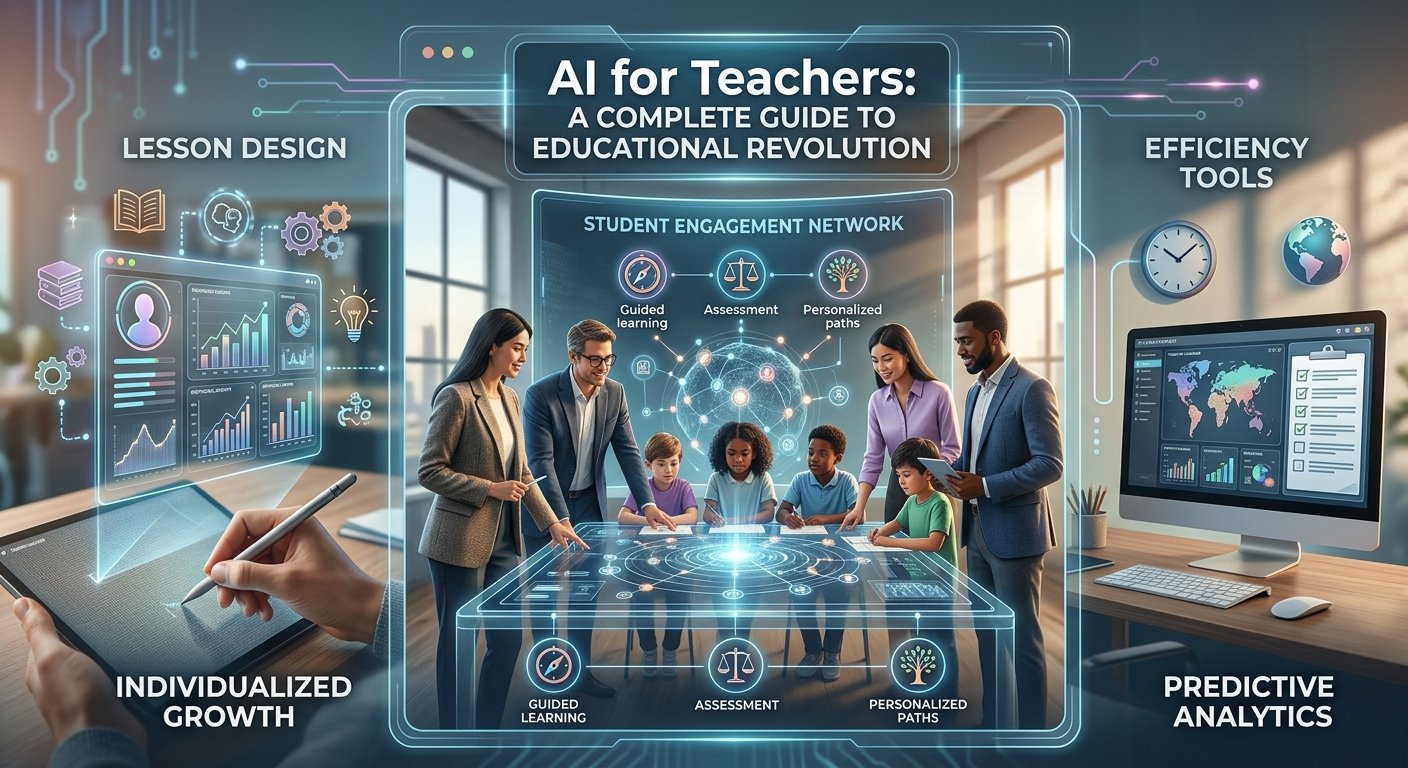
Artificial intelligence is changing the way teachers plan lessons, create educational materials, assess students, and manage their daily workload. AI for teachers is no longer simply a futuristic concept. Today, educators can use AI-powered tools to complete routine tasks faster and spend more time focusing on teaching and student interaction.
From generating lesson plans to creating quizzes and explaining difficult concepts, AI can become a useful assistant for teachers. However, it should support professional judgment rather than replace the teacher.
In this guide, we will explore how AI for teachers works, its benefits, practical applications, limitations, and responsible ways educators can use it in the classroom.
What Is AI for Teachers?
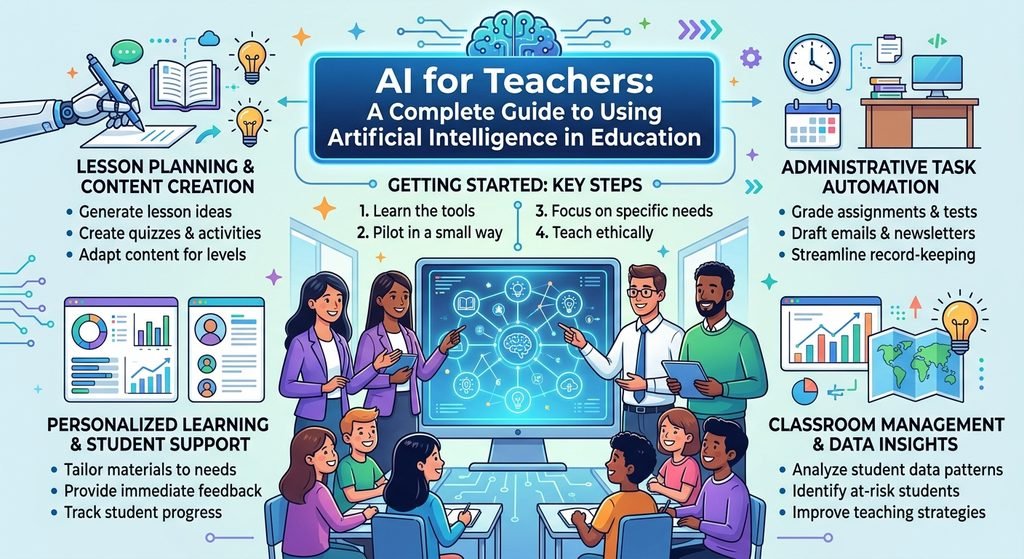
AI for teachers refers to the use of artificial intelligence technologies to support educators with teaching, planning, assessment, communication, research, and classroom management.
AI tools can process information, generate text, identify patterns, summarize content, create questions, and provide suggestions. When used appropriately, these capabilities can reduce repetitive work and help teachers develop more engaging learning experiences.
For example, a teacher could use an AI tool to:
- Create a lesson plan
- Generate multiple-choice questions
- Simplify difficult concepts
- Prepare classroom activities
- Develop discussion questions
- Create differentiated learning materials
- Summarize lengthy educational resources
- Draft parent communication
- Generate ideas for projects
- Create revision worksheets
The teacher remains responsible for checking the accuracy, suitability, and educational quality of the material.
Why Are Teachers Using AI?
Teachers often have to manage many responsibilities beyond classroom teaching. Lesson preparation, grading, administrative tasks, student communication, assessments, and resource creation can consume significant amounts of time.
AI can help automate or accelerate some of these repetitive activities.
Instead of spending hours creating a basic quiz from scratch, a teacher can ask an AI tool to generate a draft and then review and modify it. Similarly, AI can provide several lesson activity ideas within seconds.
This does not mean that teachers should rely completely on AI. Rather, AI can function as a teaching assistant that helps educators work more efficiently.
Benefits of AI for Teachers
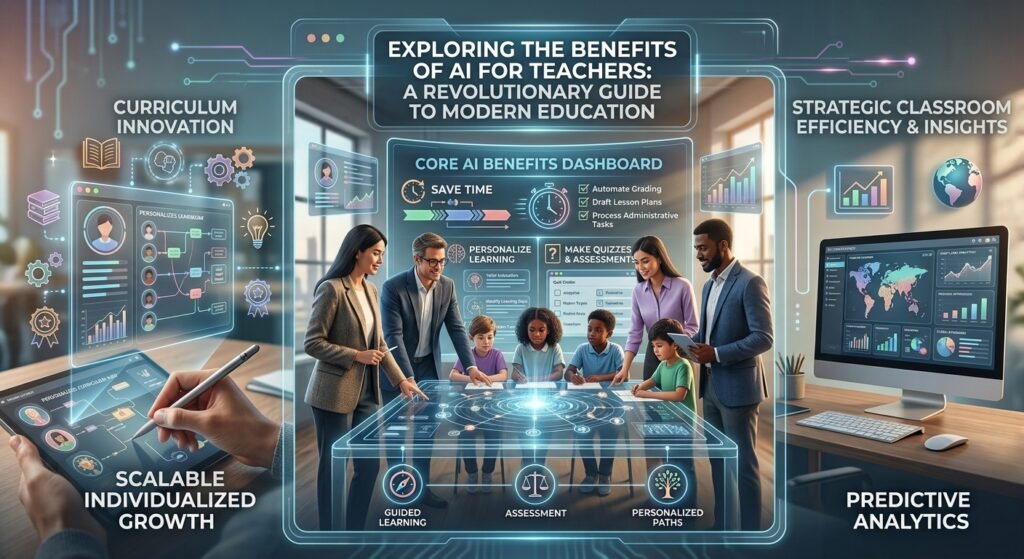
1. Saves Time
One of the biggest advantages of AI is time savings.
Teachers can use AI to create initial drafts of lesson plans, worksheets, quizzes, presentations, and classroom activities. The teacher can then edit the content according to the students’ needs.
This approach can reduce repetitive preparation work while keeping the teacher in control.
2. Helps Create Lesson Plans
Creating effective lesson plans requires objectives, activities, teaching methods, assessment strategies, and appropriate learning resources.
AI can generate a basic lesson-plan structure based on information such as:
- Subject
- Grade level
- Topic
- Learning objectives
- Lesson duration
- Student ability
Teachers can then customize the generated plan using their professional experience and knowledge of their students.
3. Supports Personalized Learning
Students have different learning abilities, interests, and educational needs.
AI can help teachers prepare different versions of learning materials. For example, a teacher could create:
- Beginner-level explanations
- Standard-level activities
- Advanced questions
- Additional practice exercises
- Simplified reading material
This can help educators provide more flexible learning experiences.
4. Creates Quizzes and Assessments
AI can quickly generate questions based on a particular topic.
Teachers can request:
- Multiple-choice questions
- True/false questions
- Short-answer questions
- Scenario-based questions
- Essay questions
- Revision tests
However, teachers should always review AI-generated questions for accuracy, appropriate difficulty, and alignment with the curriculum.
5. Generates Classroom Activities
Keeping students engaged can sometimes be challenging. AI can provide ideas for educational games, group discussions, role-playing activities, debates, projects, and problem-solving exercises.
For example, a science teacher teaching environmental pollution could ask AI for five classroom activities suitable for secondary-school students.
6. Helps Explain Difficult Concepts
Teachers can use AI to generate explanations at different levels.
A complicated scientific concept, for example, can be explained using:
- Simple language
- Real-world examples
- Analogies
- Step-by-step explanations
- Short summaries
This can help teachers adapt explanations for students who are struggling with a topic.
How Teachers Can Use AI in the Classroom
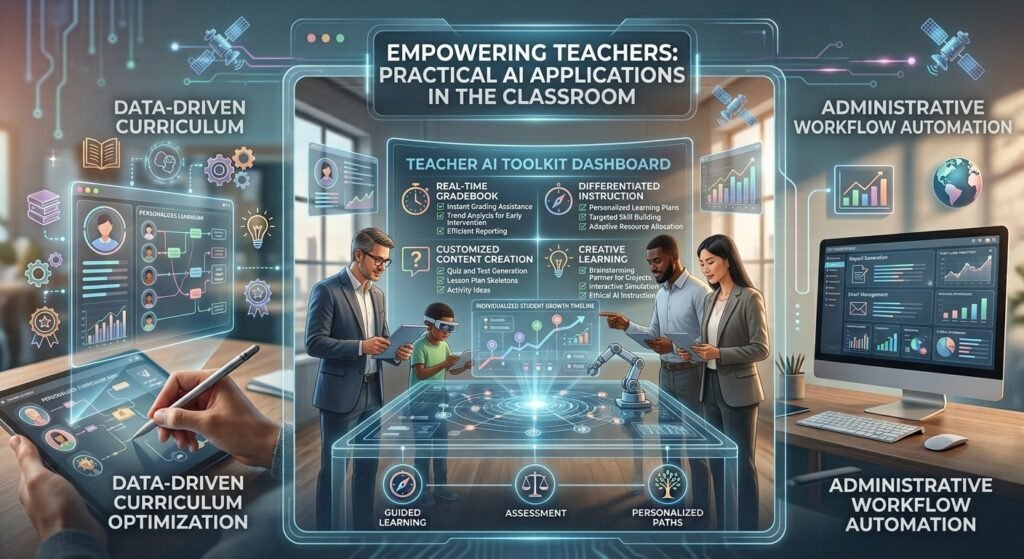
AI for Lesson Planning
Teachers can provide a topic and learning objectives and ask AI to suggest a lesson structure.
A useful prompt might be:
“Create a 45-minute lesson plan for Grade 8 students about photosynthesis, including learning objectives, activities, discussion questions, and a short assessment.”
The teacher should review the result and adapt it to the curriculum.
AI for Student Activities
AI can generate classroom activities based on the subject and age group.
For example, English teachers can request vocabulary games, writing exercises, and comprehension activities, while mathematics teachers can generate practice problems and real-world scenarios.
AI for Differentiated Instruction
Teachers can ask AI to create several versions of the same activity for students with different learning levels.
This can make classroom resources more flexible without requiring the teacher to create everything from scratch.
AI for Feedback
AI can help teachers identify grammar problems, organize feedback, and suggest areas for improvement in student work.
However, automated feedback should not automatically become the final assessment. Teachers should consider context, creativity, reasoning, and individual student circumstances.
AI Tools for Teachers
There are many categories of AI-powered tools that educators can explore.
Generative AI Tools
Generative AI can create text, ideas, questions, summaries, and other educational content based on teacher instructions.
AI Presentation Tools
Some AI-powered platforms can help educators create presentation outlines, slides, and visual teaching materials.
AI Writing Assistants
Writing assistants can help teachers draft announcements, emails, instructions, and educational resources.
AI Assessment Tools
AI-based assessment platforms can help generate questions, organize quizzes, and analyze certain types of student responses.
AI Image and Design Tools
Teachers can use AI image-generation and design tools to create illustrations, diagrams, classroom posters, and visual learning resources.
The best tool depends on the teacher’s subject, school policies, student age, privacy requirements, and available budget.
AI and Personalized Education
One of the most promising applications of AI in education is personalization.
Traditional classroom teaching often requires one teacher to support many students simultaneously. AI can help educators prepare different resources for different learning levels.
For example, if students are learning fractions, a teacher might prepare:
Level 1: Basic fraction recognition
Level 2: Addition and subtraction of fractions
Level 3: Word problems involving fractions
Level 4: Advanced problem-solving challenges
AI can help create drafts of these resources quickly.
Challenges of Using AI for Teachers
Although AI provides many benefits, educators should also understand its limitations.
1. AI Can Make Mistakes
AI-generated information can sometimes be incorrect, outdated, incomplete, or misleading.
Teachers should verify important facts before using AI-generated content with students.
2. Privacy Concerns
Teachers should avoid entering sensitive student information into AI systems unless the school’s approved system and privacy policies specifically allow it.
Personal information, confidential records, medical information, and other sensitive data require particular care.
3. Overdependence on AI
AI should assist teachers rather than replace professional judgment.
If teachers depend entirely on AI-generated lesson plans or assessments, educational quality may suffer because AI does not fully understand the classroom environment, individual student relationships, or local circumstances.
4. Academic Integrity
Students may use AI to generate assignments instead of completing their own work.
Schools and teachers therefore need clear policies about acceptable and unacceptable AI use.
Rather than simply banning AI, educators can teach students how to use it responsibly while maintaining independent thinking and original work.
How to Use AI Responsibly in Education
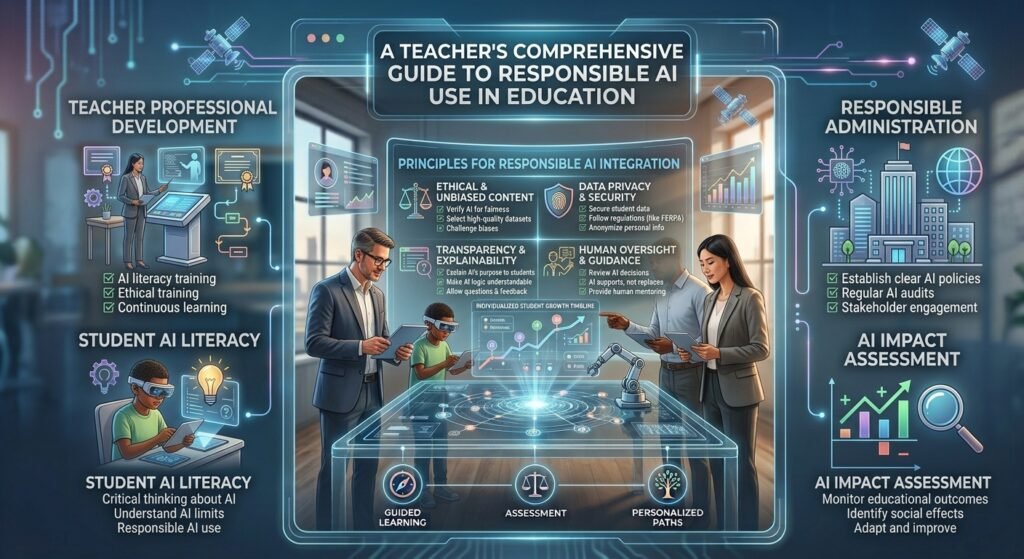
Teachers can follow several simple principles when using AI.
Review everything: Never assume that AI-generated content is automatically correct.
Protect student privacy: Avoid sharing confidential information.
Keep the teacher in control: Use AI as an assistant rather than the final decision-maker.
Encourage critical thinking: Students should learn to question and verify AI-generated information.
Follow school policies: Use AI tools according to institutional requirements.
Check for bias: AI-generated content may contain assumptions or perspectives that require review.
The Future of AI for Teachers
AI is likely to become increasingly integrated into education. Future systems may provide more sophisticated support for lesson planning, learning analytics, personalized resources, accessibility, and administrative tasks.
However, technology cannot replace the human elements of education.
Teachers provide encouragement, empathy, mentorship, classroom leadership, and personal understanding. These relationships remain central to effective education.
The future is therefore likely to involve collaboration between teachers and AI, rather than AI replacing teachers.
Conclusion
AI for teachers offers practical opportunities to save time, create educational resources, personalize learning, generate assessments, and improve classroom preparation. When used thoughtfully, AI can reduce repetitive tasks and allow educators to focus more attention on students.
At the same time, AI requires responsible use. Teachers should verify information, protect student privacy, maintain academic integrity, and apply their own professional judgment.
The most effective approach is not to let AI take over teaching but to use it as a powerful educational assistant. With the right balance between technology and human expertise, AI can become a valuable part of modern education.